
 By Elina
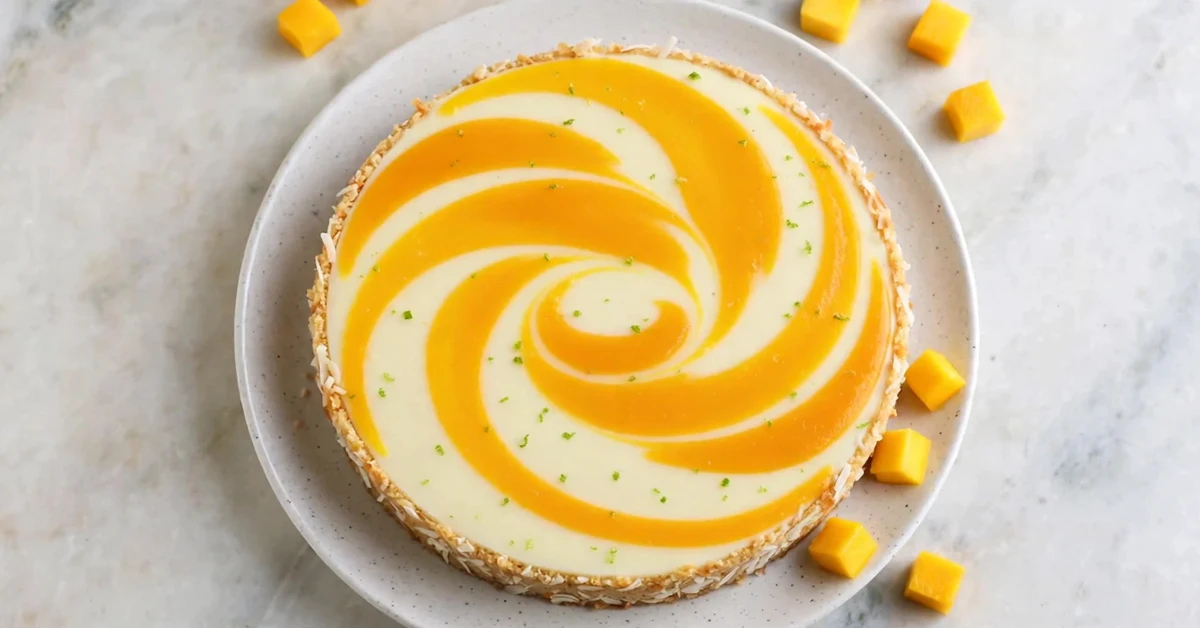
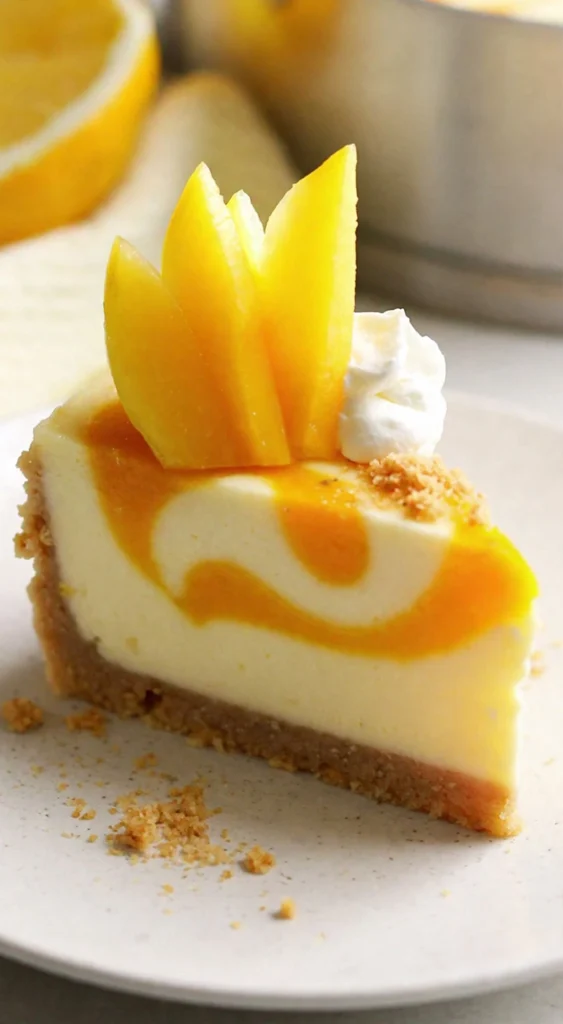
A mango swirl cheesecake is one creamy cheesecake base with ribbons of mango purée dragged through the top — and the thing that decides whether it works is the swirl: dollop the purée on the filling, drag a skewer through it once, and stop before the colours blend into one flat orange. 25 minutes of prep, 55 minutes in the oven, 4 hours chilling — 12 slices from an 8-inch springform.
The swirl is where most mango cheesecakes fail. The purée is either so thin it sinks and vanishes, or the cook stirs it so many times the top turns one uniform orange. The fix is thickness and restraint: strain the purée until it ribbons off a spoon, drop it in separate spoonfuls, and pull a skewer through each once.
One base, four mango swirl cheesecakes
The base for this mango swirl cheesecake never changes: a coconut-lime crumb crust, a cream-cheese filling sharpened with lime, and a mango purée swirl on top. What changes is how the filling sets — baked, no-bake with gelatin, baked with lemon, or no-bake without gelatin — so one shopping list gives you four different cakes.
The crust is the same for all four: graham crumbs, shredded coconut, sugar, lime zest and melted butter, pressed into an 8-inch springform and baked for 10 minutes. The filling is 24 oz (680 g) of full-fat cream cheese beaten with 3/4 cup (150 g) of sugar, 3 eggs, 1/2 cup (120 g) of sour cream, 1 teaspoon of vanilla, 2 tablespoons of lime juice and 1 tablespoon of lime zest, poured over the caramelized mango.
Make the coconut-lime crust
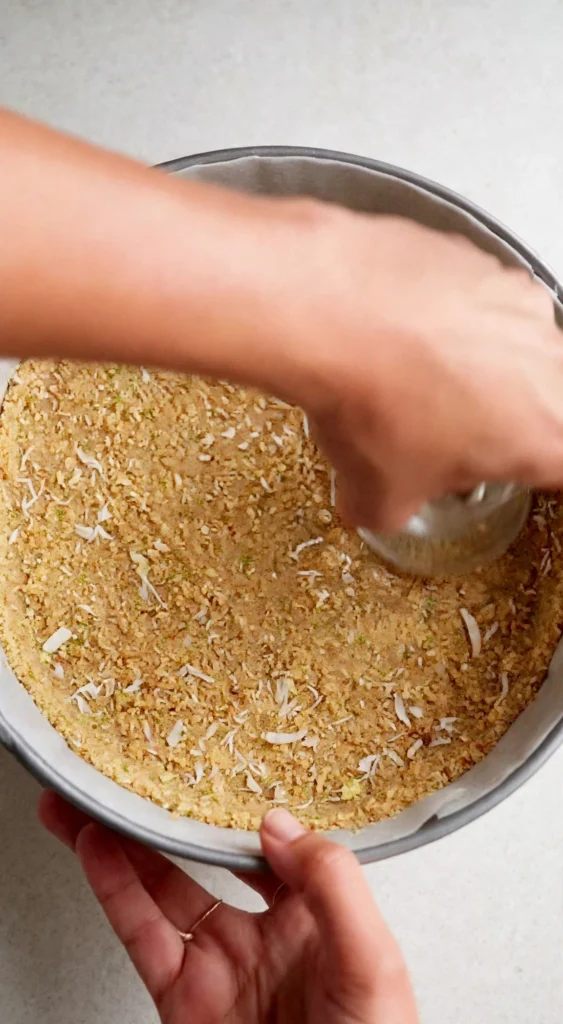
Stir 1 1/2 cups (150 g) of graham cracker crumbs with 1/2 cup (45 g) of sweetened shredded coconut, 1/4 cup (50 g) of granulated sugar and 1 tablespoon of lime zest, then pour in 6 tablespoons (85 g) of melted unsalted butter and mix until the crumbs look like wet sand. Tip into an 8-inch springform pan and press firmly over the base and 1 inch up the sides with a glass.
Bake the crust at 325°F (160°C) for 10 minutes, until the edges turn a shade darker and smell toasted. While it cools, cook 1 cup (165 g) of diced ripe mango with 2 tablespoons (25 g) of sugar and 1 teaspoon of lime juice over medium heat for about 5 minutes, until the edges turn golden and the juices thicken. Spread it over the cooled crust.
The swirl that stays on top
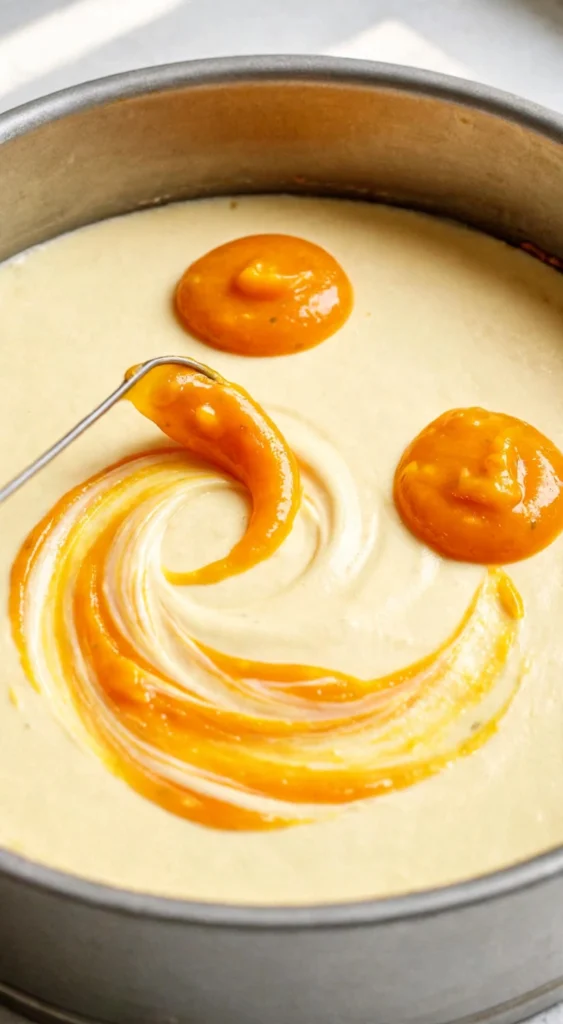
The swirl needs purée with body. Peel and chop 1 large ripe mango, blend it smooth, then push it through a fine sieve — the fibres the sieve catches are what make a swirl sink and streak. The purée should ribbon off a spoon; if it runs like juice, simmer it for 3–4 minutes until it thickens, then cool it. Hot purée melts the filling underneath it.
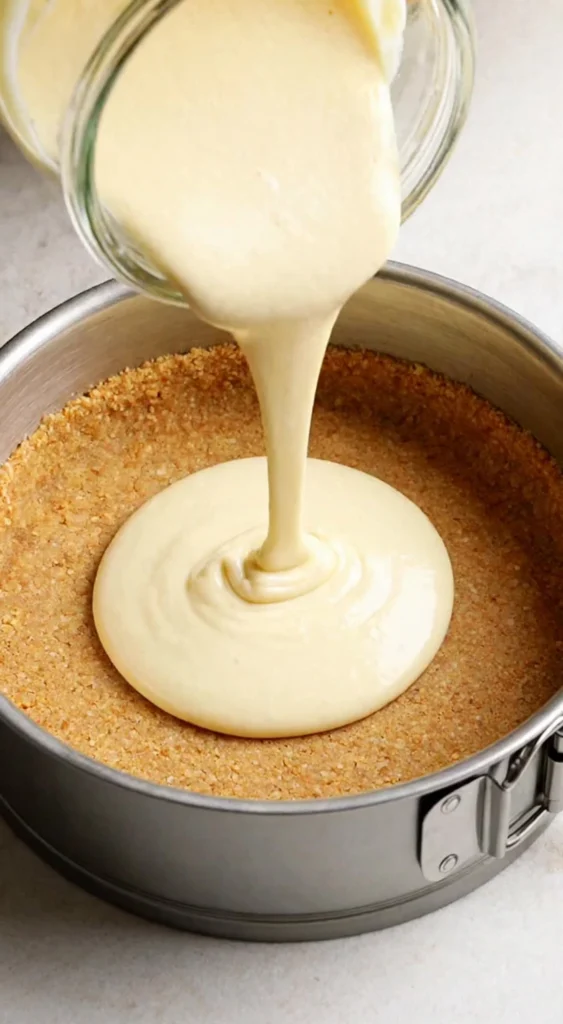
Pour the filling over the caramelized mango layer and smooth the top. Drop 5–6 spoonfuls of the strained mango purée across the surface. Take a skewer, push it into the centre of one dollop and drag it slowly through the next one in a single curved line, then lift it out. Wipe the skewer and do the next line. One pass per line is the whole technique — a second pass muddies the edge, and stirring in circles turns the top orange all over.
Baking a mango swirl cheesecake without cracks
Heat the oven to 325°F (160°C) and wrap the outside of the springform pan in a double layer of foil. Set the pan in a larger roasting tin and pour in boiling water halfway up the sides. The water bath is what keeps a baked mango swirl cheesecake from cracking: it holds the heat steady and keeps the filling moist while it sets.
Bake for 50–55 minutes. The cheesecake is done when the outer 2 inches look set and the centre still jiggles like jelly when you nudge the pan — it firms up as it cools. Turn the oven off, crack the door open and leave the cake inside for 1 hour, then move it to the fridge for at least 4 hours, or overnight. Run a thin knife around the edge before releasing the springform, so the cake does not tear.
Four ways to finish it
**1. The classic baked.** This is the recipe card below and the first way the video shows: coconut-lime crust, caramelized mango layer, baked filling, mango swirl on top. Serve it cold, in clean slices, with the swirl facing up.
**2. The quick no-bake.** Skip the oven. Bloom 1 1/2 teaspoons of gelatin in 3 tablespoons of cold water for 5 minutes, warm it gently until dissolved, and stir it into the filling with 1 cup (240 ml) of whipped cream folded in last. Pour it over the crust, swirl the purée on top and chill for 4 hours — the light, silky version the voiceover describes.
**3. Lemon-bright baked.** Add the zest of 2 lemons and 3 tablespoons of lemon juice to the filling before pouring, and bake exactly as the classic. The lemon sharpens the mango instead of competing with it. Serve with a fan of thin mango slices and whipped cream, as the video shows.
**4. Gelatin-free no-bake.** Leave the gelatin out and make the filling with 32 oz (900 g) of cream cheese and 1 cup (240 ml) of whipped cream folded in, which is enough body to hold without a setting agent. Chill for 6 hours, then cut into squares or triangles and serve straight from the fridge, as in the video’s final spread.
When the swirl sinks — and the fix
A swirl that disappears into the filling means the purée was too thin, or the filling was too warm when the purée went on. Strain the purée, simmer it down if it runs, and let the filling sit for 5 minutes after pouring so the surface firms before you dollop. If the swirl has already sunk, spoon extra purée over the top before serving and call it a sauce.
A cracked top means the oven ran too hot or the cake cooled too fast. Bake at 325°F (160°C) with the water bath, and cool the cake in the turned-off oven with the door ajar for an hour. A crack can be covered with the reserved purée or whipped cream.
A soggy crust means the butter was short or the crust was not pressed firmly enough. The crumbs should clump when squeezed in a fist; if they fall apart, add another tablespoon of melted butter. Press with the bottom of a glass, not your fingers, so the layer is even.
Swaps for the pantry you have
Swap the mango: frozen mango works for the purée if you thaw it fully and drain the excess liquid — the swirl will be slightly less bright, but the flavour holds. Canned mango purée works too; use an unsweetened one and cut the sugar in the filling by 2 tablespoons.
Swap the crust: digestive biscuits replace graham crackers at the same weight, and desiccated coconut replaces shredded coconut. Leave the coconut out entirely and the crust still works, but you lose the toasted edge.
Swap the lime: lemon zest and juice replace lime one-for-one in the crust and the filling, and the result is closer to the lemon-bright way. Orange zest works in the crust, but it is sweeter and the cheesecake loses its edge.
How to store mango swirl cheesecake
A mango swirl cheesecake keeps best covered in the fridge for up to 4 days. The swirl holds its colour for the first two days, then the mango starts to darken at the edges — it still tastes the same. Cut slices with a hot, dry knife and wipe the blade between cuts.
It freezes for up to 1 month: freeze the whole cake or individual slices on a tray until solid, then wrap tightly. Thaw overnight in the fridge, never on the counter, or condensation will spot the swirl. The no-bake versions freeze less well than the baked one — the gelatin-free version softens and is best eaten within 2 days of making.
More desserts to try: Mango Charlotte Cheesecake · Mango Mousse · No-Bake Cherry Cheesecake
The closest mango neighbour on the site is the Mango Charlotte Cheesecake — the same ripe-mango flavour in a no-bake ladyfinger frame, if you want the tropical side without the oven. That is the point of this mango swirl cheesecake: one base, four ways to serve it, and the swirl doing the talking. Watch all four ways in the CraveWave Kitchen Short — [Short link to be added once video #14 posts in slot 2 Fri 2026-11-13].
