
 By Elinaa
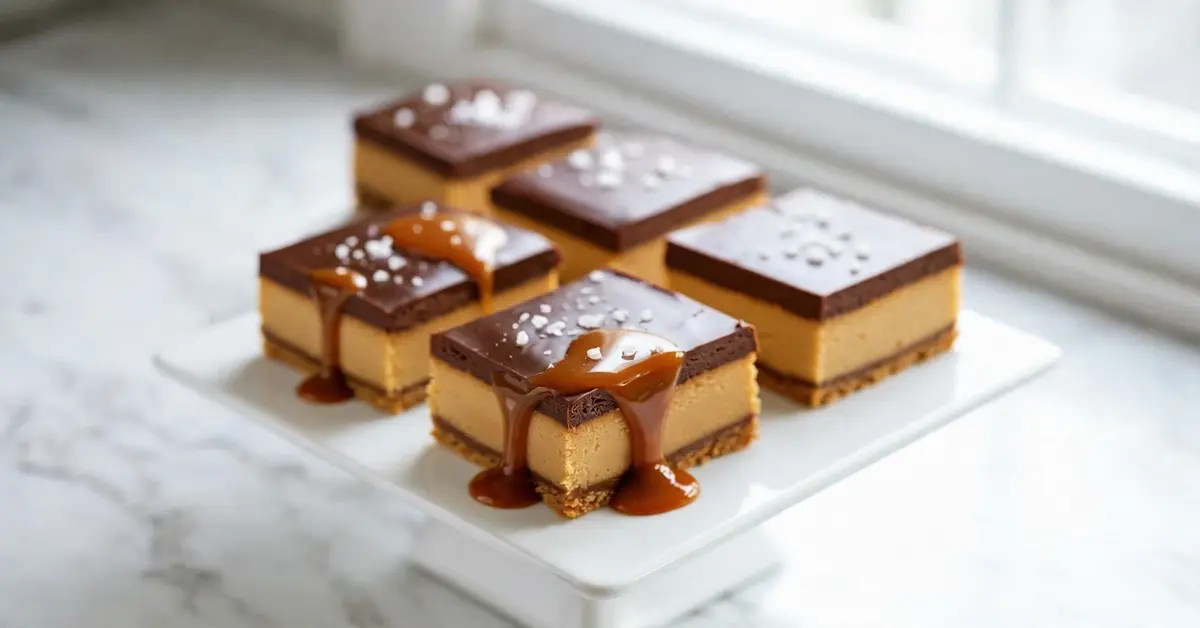
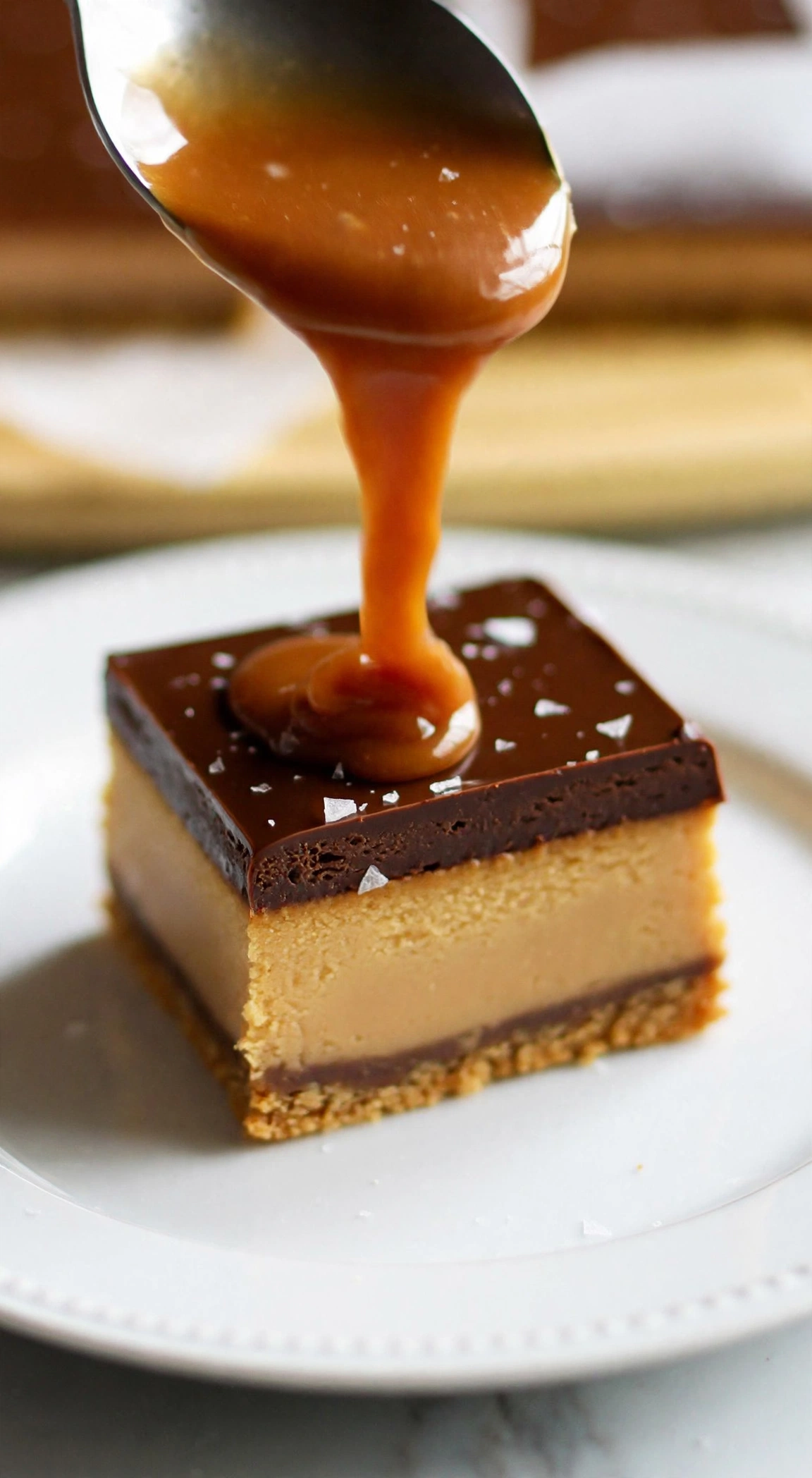
These salted caramel cheesecake bars are the round cheesecake’s portable cousin: the same buttery shortbread base, caramel cream-cheese filling and glossy ganache — set in a square pan, cut into 16 clean squares, and finished with a caramel drizzle and flaky sea salt. Thirty minutes of hands-on work, no oven, and a 5-hour chill that does the setting. What decides the result is the salt: without it the caramel tastes one-note sweet; with it, the bars taste balanced enough to eat two.
Why salted caramel cheesecake bars cut cleaner than a round cheesecake
A round cheesecake fights the knife twice: the domed top cracks under the blade and the curved edge gives no straight line to follow. A square pan gives straight sides and a flat ganache sheet that sets level, so one firm cut with a hot knife leaves a clean edge on every bar. The same flavours live in the site’s round no-bake caramel cheesecake — the bars are that recipe’s format, not a different dessert. The cold set works the same way: butter firms the crust, cream cheese gives the filling its body, and whipped cream holds air only while its fat stays chilled, the same principle that sets the banoffee cheesecake. The difference is the finish: ganache poured over a chilled filling sets into a thin, snappable sheet, and flaky salt on top stays crunchy because it never meets heat.
The shortbread crust, pressed flat and chilled hard
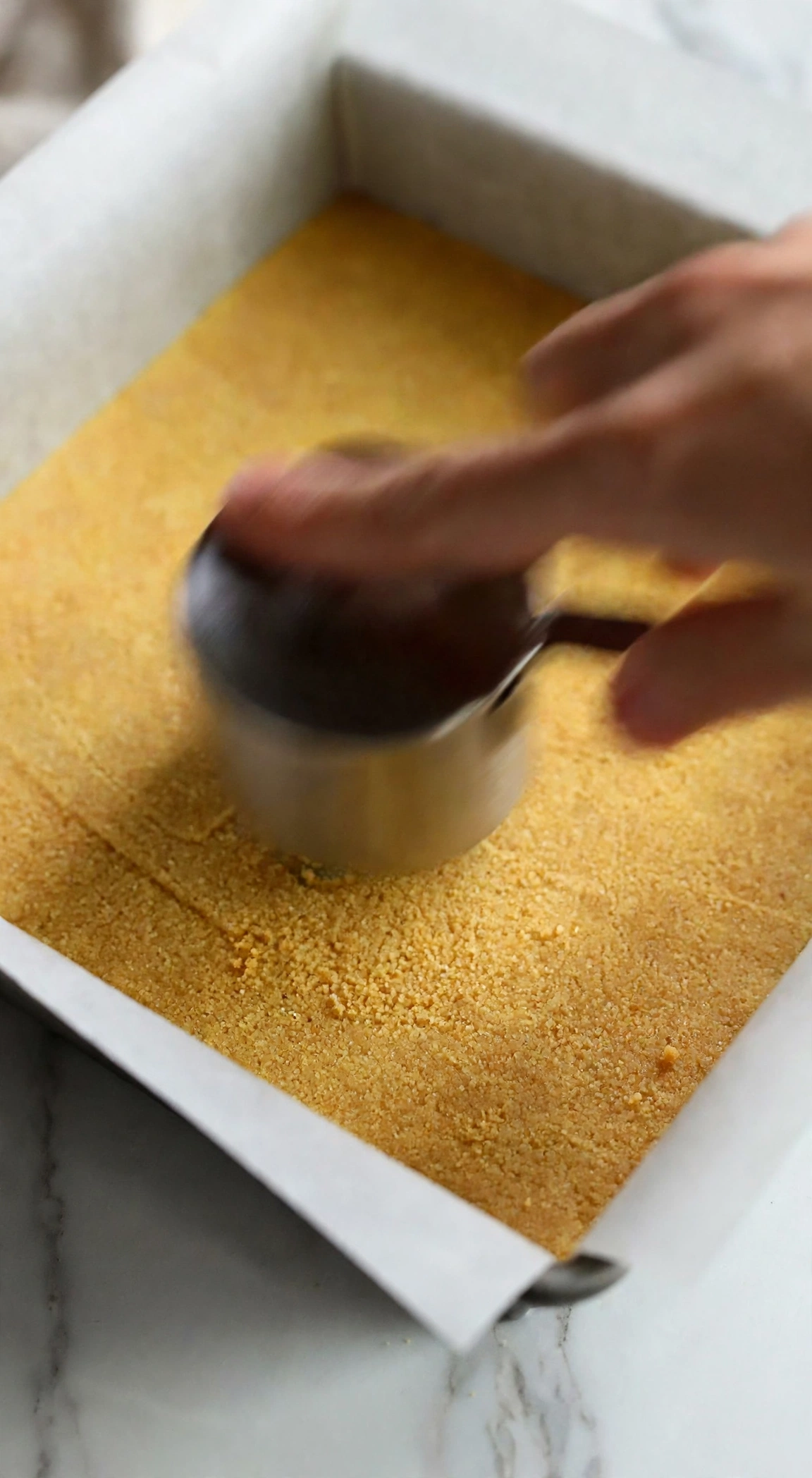
Shortbread crumbs and melted butter make a base that cuts cleanly instead of crumbling. Crush the cookies fine and even — coarse chunks leave weak spots that crack when the slab lifts out. Press firmly and evenly across the base and into the corners with the flat bottom of a measuring cup, then chill for the full 30 minutes so the butter re-firms and the filling’s moisture cannot seep down into it. The same biscuit base carries the dark chocolate cheesecake, where it holds up under a baked filling and a ganache crown.
What goes in the filling, and the swaps that still set
Shortbread crust:
- 1 1/2 cups (150 g) shortbread cookie crumbs
- 5 tablespoons (70 g) unsalted butter, melted
Caramel cream-cheese filling:
- 16 oz (450 g) full-fat cream cheese, at room temperature
- 3/4 cup (90 g) powdered sugar
- 1/2 cup (120 ml) caramel sauce
- 1 teaspoon vanilla extract
- 1 1/4 cups (300 ml) heavy cream, cold
Chocolate ganache:
- 6 oz (170 g) dark chocolate, chopped
- 1/2 cup (120 ml) heavy cream
To finish:
- 1/4 cup (60 ml) caramel sauce, for drizzling
- 1 teaspoon flaky sea salt
Block cream cheese only — the spreadable tub kind carries extra water and the filling stays soft. With no heat in the method, granulated sugar never dissolves, so powdered sugar is required. Flaky salt is required too: fine salt dissolves into the caramel and the crunch is gone. Use a caramel sauce thick enough to ribbon off a spoon; a thin sauce thins the filling and the bars slump.
Graham cracker crumbs replace shortbread at the same weight, with a plainer, sweeter base. Store-bought caramel sauce works in both places; homemade sauce must cool to room temperature first, or it melts the filling. Semi-sweet chocolate swaps for dark at the same weight — keep the cream the same, or the ganache sets too soft to snap.
The ganache layer that makes salted caramel cheesecake bars slice clean
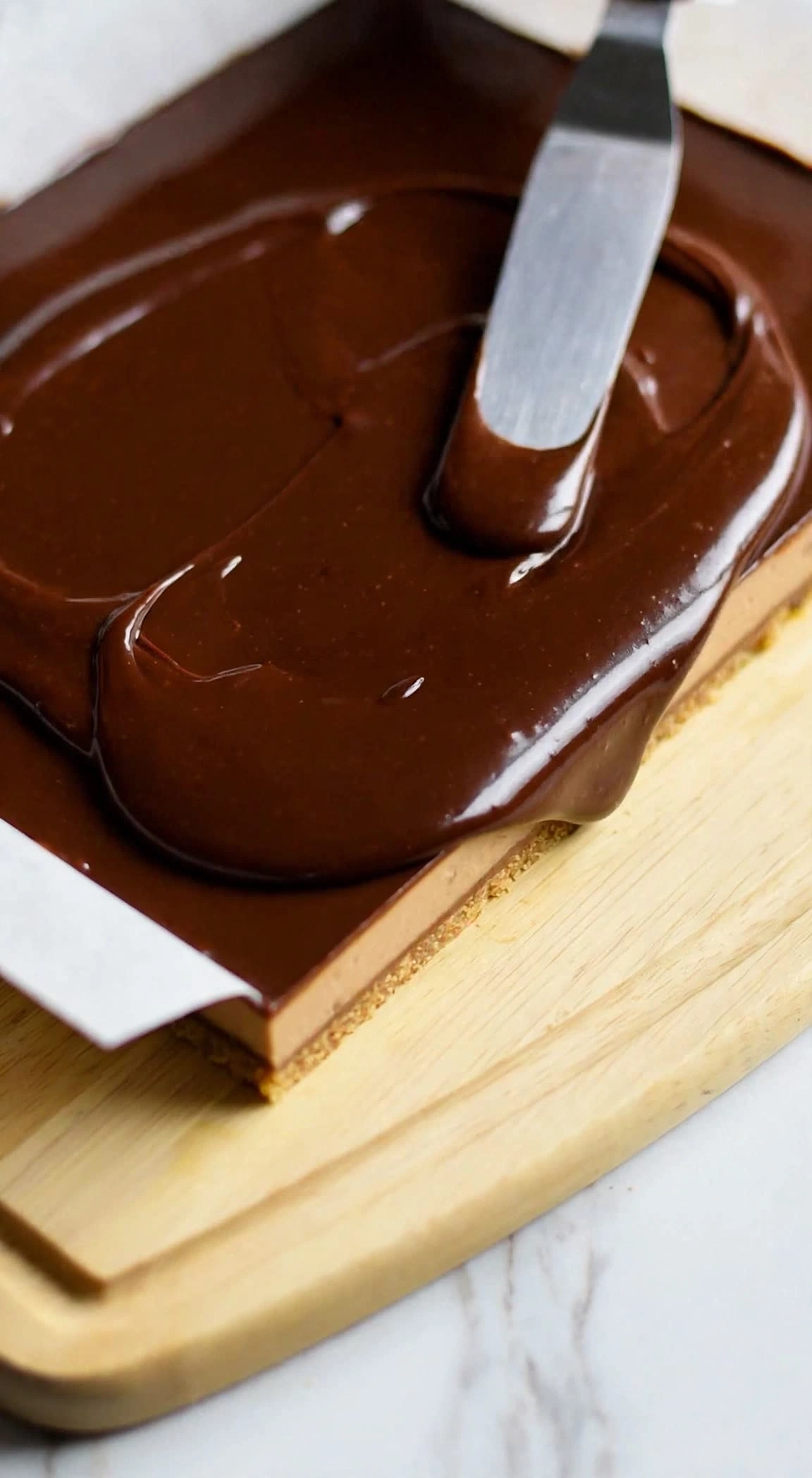
The ganache is one part chocolate to a little under one part cream by weight — 170 g chocolate to 120 ml cream — which sets firm enough to snap under a knife and soft enough to bite without shattering. Pour it over a filling chilled for 30 minutes; warm ganache on a soft filling sinks and the layers blur. Tilt the pan and smooth no more than twice — the surface levels itself. Too thick and it cracks when cut; too thin and it tears, showing the filling. The ratio below lands in the middle, a layer about 3 mm thick.
Method: crust, filling, ganache, cut
The order matters in these salted caramel cheesecake bars: crust first and chilled, filling beaten and folded, a short chill so the ganache lands on a firm surface, then the long set before any knife touches the slab.
- Line the pan. Line an 8-inch square pan with parchment, leaving a 2-inch overhang on two sides — the overhang is the handle that lifts the whole slab out for cutting.
- Press and chill the crust. Stir the melted butter through the shortbread crumbs until the mixture clumps when squeezed. Tip into the pan and press firmly and evenly across the base and into the corners with the flat bottom of a measuring cup. Chill for 30 minutes, until hard.
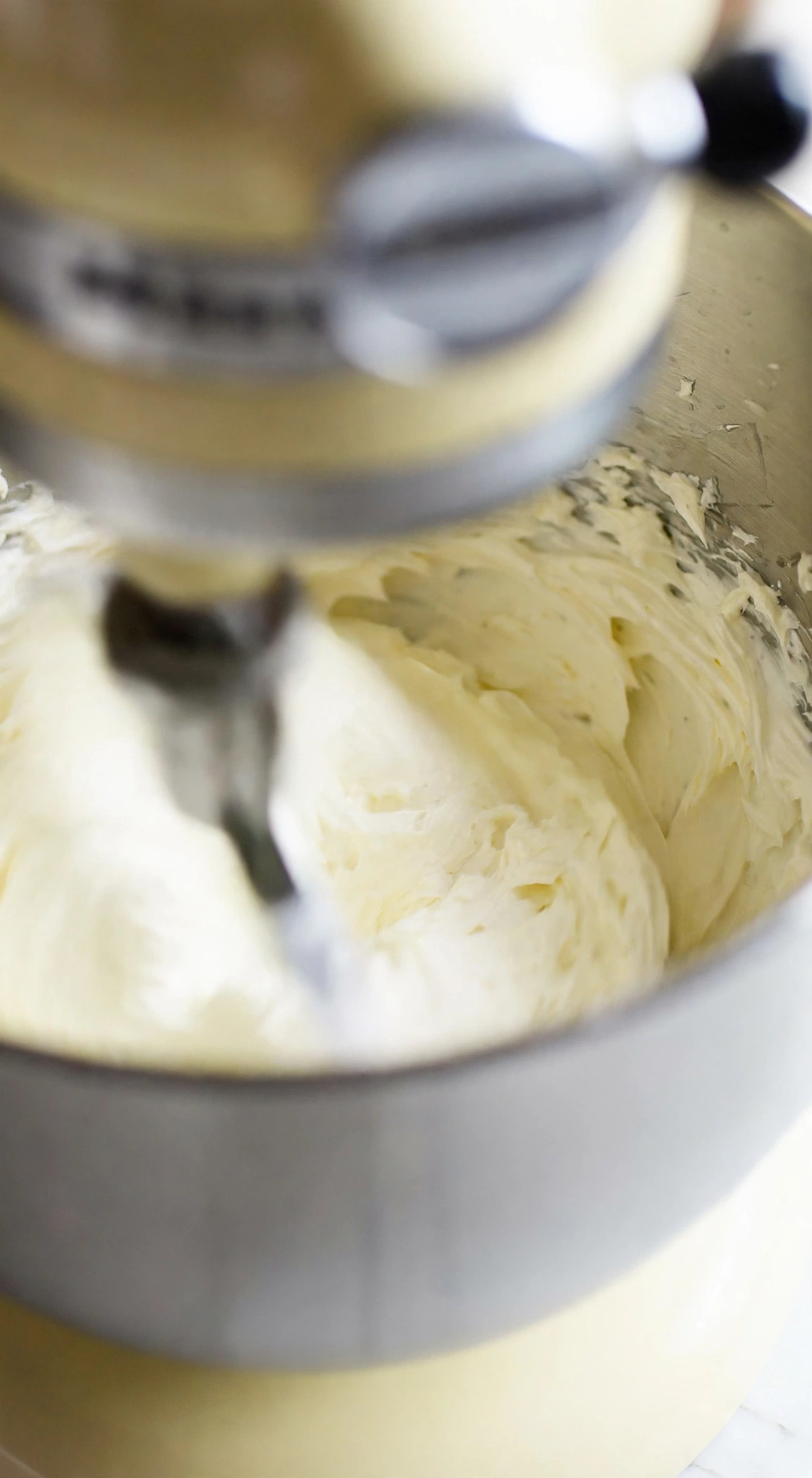
- Beat the cream-cheese base. Beat the room-temperature cream cheese with the powdered sugar and vanilla for about 2 minutes, until smooth with no lumps, scraping the bowl once halfway through. Fold in the 1/2 cup caramel sauce until the colour is even — no pale streaks left.
- Whip the cream and fold it in. In a separate cold bowl, whip the cold heavy cream to stiff peaks. Fold it through the caramel cream-cheese mixture in two additions with a spatula, keeping as much air as possible — the same fold, never a beat, is what keeps the no-bake Oreo cheesecake filling tall.
- Spread the filling and chill briefly. Spread the filling over the cold crust and smooth the top with an offset spatula. Chill for 30 minutes, until the surface is firm to a light touch — this is the firm surface the ganache needs.
- Pour the ganache. Heat the 1/2 cup cream until it just simmers, pour over the chopped chocolate, rest 2 minutes, then stir from the centre until glossy. Pour over the chilled filling and tilt the pan to level it, smoothing no more than twice. Refrigerate at least 4 hours, or overnight, until the ganache is set and the filling is firm.
- Cut, drizzle and salt. Lift the slab out by the parchment overhang. Cut into 16 bars (4 by 4) with a long, hot knife, wiping the blade clean between cuts. Spoon the remaining 1/4 cup caramel sauce in a slow drizzle over each bar and scatter the flaky sea salt over the top just before serving.
Where the bars go wrong
Most failures in salted caramel cheesecake bars show up at the knife.
Ganache cracks when cut. The slab went under the knife too cold, or the ganache is too thick. Fix it with a hot knife: dip the blade in hot water, wipe it dry, cut one line, repeat — never saw back and forth.
Filling too soft to hold a square. The cream was under-whipped, or too much caramel thinned the base. No rescue exists after the pour — whip the cream to full stiff peaks, keep the caramel to the 1/2 cup in the list, and give it the full 4-hour chill.
Crust crumbles when the slab lifts. Crumbs too coarse, or pressed too lightly. Fix it with fine, even crumbs and a hard press into the corners; a loose crust never firms up later.
Serving and storing salted caramel cheesecake bars
These salted caramel cheesecake bars are a make-ahead dessert by design: the filling needs its 4 hours, so they are a day-ahead tray, not an hour-ahead one. Covered in the fridge, they keep up to 4 days; the ganache seals the top, so the drizzle stays glossy.
Freeze leftovers as bars on a tray until solid, then wrap and freeze up to 1 month; thaw in the fridge, never on the counter, so the filling does not sweat. Get bars back into the fridge within 2 hours of serving, and scatter the salt at the table — overnight it dissolves into the caramel and the crunch is gone.
For another dessert that cuts into squares from the same pan, the cheesecake brownies use the same lift-out-by-parchment cut. Watch the caramel drizzle land in the CraveWave Kitchen Short — [Short link to be added once video #5 posts in slot 2, ~04:13 PKT].
